Making hay while the sun shines
- Intro
- Life
- "All the world's a stage"
- Fast facts about Shakespeare
- Shakespeare's childhood
- Shakespeare's schooling
- Shakespeare's Youth
- Courtship and marriage
- Marriage: speculation
- Married life
- The Shakespeare family
- The "lost years"
- Character assassination?
- The upstart crow
- An attack on Shakespeare
- The attack retracted
- The early plays
- Experimental plays
- A patron, poems, a plot
- Dedication and friendship
- More about the patron
- The plot thickens
- An ambiguous dedication
- Characters in the Sonnets
- Bare, ruined choirs . . .
- Back to facts
- A comedy of errors
- Popularity and publication
- Shakespeare's early maturity
- Shakespeare's maturity
- Last years in London
- Shakespeare in retirement
- Stage
- Society
- Country life
- Huswifery
- The housewife's duties
- The advice continues. . .
- The plan of a farmhouse
- In sickness and in health
- Distillation
- Childbirth
- A christening
- The Birth of the Virgin
- Women and kitchens
- Preparing food
- More recipes
- Diet: food as medicine
- The dairy
- The yard
- A design for a garden
- Flax and hemp
- To market, to market
- Market Purchases
- Economic importance
- Husbandry
- The family
- City life
- The City of London
- The procession in full
- London: streets and bridges
- A procession
- Districts within London
- London Bridge
- The cost of living
- Coins and money
- The marketplace
- Fish market
- Guilds
- The Guild System
- Various trades
- The life of a soldier
- Join the army
- Begging and vagrancy
- Compassion
- Bedlam: madness
- Madness
- Outsiders: black
- Outsiders: Jewish
- A tavern meal
- Gambling
- A bawdy-house
- City sports: bear-baiting
- The Paris Garden
- Bull-baiting
- The sewers of London
- The plague
- Death and mortality
- Court life
- History
- Legend and early history
- The history of the Histories
- Two chronologies
- Shakespeare's sources
- Early kings (1)
- Early kings (2)
- Richard Lionheart
- King John
- Richard II
- Richard's downfall
- Peasants' revolutions
- A rebellion defused
- Jack Cade
- Monarchs of the Histories
- An early geneology
- The dynastic jigsaw
- Henry IV
- Henry IV (2)
- Henry IV (3)
- Henry V
- The real Falstaff
- Henry VI
- Henry VI (2)
- Wars of the Roses (1)
- Wars of the Roses (2)
- Joan of Arc
- Richard III
- Richard's death
- Henry VII
- The Tudor myth
- A shift in power
- Saint George
- The technology of warfare
- Henry VIII
- The reign of Elizabeth
- Princess Elizabeth
- Her education
- She becomes queen
- The Virgin Queen
- Elizabeth praying
- Elizabeth's popularity
- Mary, Queen of Scots
- A scandal
- The Catholics
- The Armada
- The Armada (2)
- Elizabeth and Essex
- Court heirarchy
- Administrative offices
- The Privy Council
- Officers of the Court
- Court finances
- Parliament
- Religion and Parliament
- The rising middle class
- The reign of James I
- Crime and the law
- The puritan movement
- Ideas
- The medieval universe
- Putting nature in order
- An orderly world
- Steps, ladder, chain, scale
- An orderly progression
- The music of the spheres
- Order within order
- A chain of status
- The nobility and genry
- The Commonalty
- Order in the sexes
- Adam and Eve
- Primary qualities
- A table of equivalents
- More foursomes
- The humours (1)
- The humours (2)
- The humours (3)
- How to treat a fever
- Correspondences
- Microcosm/macrocosm
- Signs and the body
- Disorder
- Disorder (2)
- Education
- New knowledge
- A rebirth of knowledge
- The humanists
- Sir Thomas More
- Sir Thomas More's family
- Myth rediscovered
- Old tales in a new light
- The sun in the center
- The "new philosophy"
- Alchemy and chemistry
- Distillation
- The scientific method
- Magic or botany?
- From icon to image
- Renaissance realism
- The water closet
- Machiavelli
- Shakespeare's Machiavelli
- You be the judge. . .
- Montaigne
- The New World
- Travellers' tales
- Religion
- The early church in England
- Henry VIII and the break with Rome
- Crown v. church
- The dissolution of the monasteries
- The Book of Common Prayer
- The Homilies
- Translations of the Bible
- Shakespeare and the Bible
- Edward VI and Mary I: extremes
- Elizabeth's "via media"
- Going to church (1)
- Going to church (2)
- Protestantism: Martin Luther
- Faith, scripture, grace
- John Calvin
- The Zwinglians
- The Counter-Reformation
- The religion of love: courtly love
- Death: the undiscovered country
- Suicide: an act of dignity or despair?
- Suicide on stage
- The supernatural
- Drama
- Literature
- Elizabethan English
- Elizabethan poetry
- Elizabethan Prose
- Women writers
- Renaissance publishing
- Art in Renaissance England
- Medieval Art
- Medieval to Renaissance . . .
- Gothic art
- The Renaissance
- Flight into Egypt
- Perspective
- New techniques
- Patronage
- Studies from the antique
- Myth explored
- High Renaissance: Raphael
- The cartoon reversed
- Architecture and painting
- Saint Paul (reversed)
- Titian: Venus and Adonis
- Mannerism
- Classicism and anachronism
- Art in the north of Europe
- Flemish art
- Bruegel: ordinary people
- Bruegel: slices of life
- Art in England
- Domestic art in England
- Art in England: Mini-art
- Architecture in England
- Music in England
- Plays
- Hamlet, Prince of Denmark
- The Ghost
- The Court
- Staging the opening
- Revenge
- "Incestuous sheets"
- Hamlet and women
- University student
- Hamlet as actor
- Madness: Hamlet
- Madness: Ophelia
- The duel
- Divine right?
- Claudius: politician
- Ordinary people
- The ending: Fortinbras
- Order restored?
- Hamlet and tragedy
- The sources of Hamlet
- The text: solid or sullied?
- The Taming of the Shrew
- A Midsummer Night's Dream
- Romeo and Juliet
- The Merchant of Venice
- Henry IV, Part 1
- Henry V
- Much Ado About Nothing
- As You Like It
- Julius Caesar
- Twelfth Night
- Measure for Measure
- Othello
- King Lear
- Macbeth
- The Winter's Tale
- The Tempest
- Hamlet, Prince of Denmark
- Reference
- Chronology
- Shakespeare's plays
- Plays: 1588-1595
- Plays: 1592-1598
- Plays: 1588-1595
- Plays: 1602-1610
- Plays: 1609-1615
- BCE [BC] to CE [AD] 500
- Years 500-1000
- Years 1000-1300
- Years 1300-1499
- Years 1500-1555
- Years 1556-1558
- Years 1559-1562
- Years 1563-1565
- Years 1566-1568
- Years 1569-1571
- Years 1572-1574
- Years 1575-1577
- Years 1578-1581
- Years 1582-1585
- Years 1586-1587
- Years 1588-1590
- Years 1591-1592
- Years 1593-1594
- Years 1595-1596
- Years 1597-1598
- Years 1599-1601
- Years 1602-1603
- Years 1604-1606
- Years 1607-1608
- Years 1609-1611
- Years 1612-1613
- Years 1614-1615
- Years 1616-1619
- Years 1620-1623
- Shakespeare's Sources
- Maps of Shakespeare's time
- Bibliographies
- Shakespeare's life
- Shakespeare's stage
- Moralities and mysteries
- The masque
- The stage and staging
- Staging (sources)
- Actors and acting
- The audience
- Society
- Women in the Renaissance
- Courtship and marriage
- Family and children
- The housewife
- The husbandman
- City life
- Outsiders
- Court life
- History and politics
- Shakespeare's "prehistory"
- Shakespeare's Rome
- The history of the Histories
- Joan of Arc
- The Tudors
- Peasant uprisings
- Elizabeth I
- James I
- Crime and the law
- The puritans
- The background of ideas
- The cosmos and "order"
- Science and astrology
- Education
- New knowledge
- Religion
- Churchgoing
- The occult and folklore
- Witches and witchcraft
- The drama (general)
- Classical drama
- Medieval drama
- Tragedy
- Comedy
- Histories
- Shakespeare's contemporaries
- Renaissance literature (general)
- Elizabethan language
- Poetry
- Prose
- Women writers
- Printing and publishing
- Courtly love
- Art, architecture, and music
- Architecture
- Music
- Reference works
- Frequently Asked Questions
- What makes Shakespeare great?
- Shakespeare's life
- Shakespeare's life (2)
- Shakespeare's stage
- Shakespeare's stage (2)
- Renaissance society
- Renaissance society (2)
- Renaissance society (3)
- History and politics
- History and politics (2)
- History and politics (3)
- The background of ideas
- The background of ideas (2)
- The background of ideas (3)
- Questions about literature
- Literature (2)
- Printing and Renaissance art
- Architecture and music
- Chronology
- Help

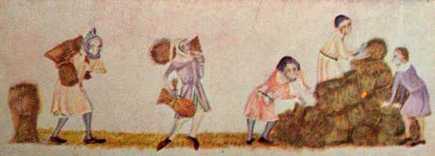
Harvesting. From the Luttrell Psalter. Reproduced in Social England, ed. H.D.Traill. University of Victoria Library.
Carpe Diem. Seize the day. Summer's lease hath all too short a date.
When lofty trees I see barren of leaves,
Which erst from heat did canopy the herd,
And summer's green, all girded up in sheaves,
Born on the bier with white and bristly beard;
Then of thy beauty do I question make,
That thou among the wastes of time must go,
Since sweets and beauties do themselves forsake,
And die as fast as they see others grow. . .
(Sonnet 12, to the Young Man)
Summer's orderly bees...
In Henry V, the Archbishop of Canterbury argues that human society is like a hive of bees: (1.2.188-94)
". . . Creatures that by a rule in nature teach
The act of order to a peopled kingdom.
They have a king, and officers of sorts,
Where some like magistrates correct at home,
Others like merchants venture trade abroad,
Others like soldiers armèd in their stings
Make boot upon the summer's velvet buds. . ."
Footnotes
-
Bees and farming
Compare Gervase Markham's comments in a treatise on farming:
Of all the creatures which are behoveful for the use of man, there is none more necessary, wholesome, or more profitable than the bee, nor any less troublesome, or less chargeable.
To speak then first of the nature of bees, it is a creature gentle, loving, & familiar about the man, which hath the ordering of them, so he come neat, sweet, and cleanly amongst them: otherwise, if he have strong, and ill-smelling favours about him, they are curst and malicious, and will sting spitefully: they are exceeding industrious and much given to labour, they have a kind of government amongst themselves, as it were a well ordered commonwealth: every one obeying and following their king or commander, whose voice (if you lay your ear to the hive) you shall distinguish from the rest, being louder and greater, and beating with a more solemn measure.From Gervase Markham, A Way to Get Wealth (1632).
