The players

- Intro
- Life
- "All the world's a stage"
- Fast facts about Shakespeare
- Shakespeare's childhood
- Shakespeare's schooling
- Shakespeare's Youth
- Courtship and marriage
- Marriage: speculation
- Married life
- The Shakespeare family
- The "lost years"
- Character assassination?
- The upstart crow
- An attack on Shakespeare
- The attack retracted
- The early plays
- Experimental plays
- A patron, poems, a plot
- Dedication and friendship
- More about the patron
- The plot thickens
- An ambiguous dedication
- Characters in the Sonnets
- Bare, ruined choirs . . .
- Back to facts
- A comedy of errors
- Popularity and publication
- Shakespeare's early maturity
- Shakespeare's maturity
- Last years in London
- Shakespeare in retirement
- Stage
- Society
- Country life
- Huswifery
- The housewife's duties
- The advice continues. . .
- The plan of a farmhouse
- In sickness and in health
- Distillation
- Childbirth
- A christening
- The Birth of the Virgin
- Women and kitchens
- Preparing food
- More recipes
- Diet: food as medicine
- The dairy
- The yard
- A design for a garden
- Flax and hemp
- To market, to market
- Market Purchases
- Economic importance
- Husbandry
- The family
- City life
- The City of London
- The procession in full
- London: streets and bridges
- A procession
- Districts within London
- London Bridge
- The cost of living
- Coins and money
- The marketplace
- Fish market
- Guilds
- The Guild System
- Various trades
- The life of a soldier
- Join the army
- Begging and vagrancy
- Compassion
- Bedlam: madness
- Madness
- Outsiders: black
- Outsiders: Jewish
- A tavern meal
- Gambling
- A bawdy-house
- City sports: bear-baiting
- The Paris Garden
- Bull-baiting
- The sewers of London
- The plague
- Death and mortality
- Court life
- History
- Legend and early history
- The history of the Histories
- Two chronologies
- Shakespeare's sources
- Early kings (1)
- Early kings (2)
- Richard Lionheart
- King John
- Richard II
- Richard's downfall
- Peasants' revolutions
- A rebellion defused
- Jack Cade
- Monarchs of the Histories
- An early geneology
- The dynastic jigsaw
- Henry IV
- Henry IV (2)
- Henry IV (3)
- Henry V
- The real Falstaff
- Henry VI
- Henry VI (2)
- Wars of the Roses (1)
- Wars of the Roses (2)
- Joan of Arc
- Richard III
- Richard's death
- Henry VII
- The Tudor myth
- A shift in power
- Saint George
- The technology of warfare
- Henry VIII
- The reign of Elizabeth
- Princess Elizabeth
- Her education
- She becomes queen
- The Virgin Queen
- Elizabeth praying
- Elizabeth's popularity
- Mary, Queen of Scots
- A scandal
- The Catholics
- The Armada
- The Armada (2)
- Elizabeth and Essex
- Court heirarchy
- Administrative offices
- The Privy Council
- Officers of the Court
- Court finances
- Parliament
- Religion and Parliament
- The rising middle class
- The reign of James I
- Crime and the law
- The puritan movement
- Ideas
- The medieval universe
- Putting nature in order
- An orderly world
- Steps, ladder, chain, scale
- An orderly progression
- The music of the spheres
- Order within order
- A chain of status
- The nobility and genry
- The Commonalty
- Order in the sexes
- Adam and Eve
- Primary qualities
- A table of equivalents
- More foursomes
- The humours (1)
- The humours (2)
- The humours (3)
- How to treat a fever
- Correspondences
- Microcosm/macrocosm
- Signs and the body
- Disorder
- Disorder (2)
- Education
- New knowledge
- A rebirth of knowledge
- The humanists
- Sir Thomas More
- Sir Thomas More's family
- Myth rediscovered
- Old tales in a new light
- The sun in the center
- The "new philosophy"
- Alchemy and chemistry
- Distillation
- The scientific method
- Magic or botany?
- From icon to image
- Renaissance realism
- The water closet
- Machiavelli
- Shakespeare's Machiavelli
- You be the judge. . .
- Montaigne
- The New World
- Travellers' tales
- Religion
- The early church in England
- Henry VIII and the break with Rome
- Crown v. church
- The dissolution of the monasteries
- The Book of Common Prayer
- The Homilies
- Translations of the Bible
- Shakespeare and the Bible
- Edward VI and Mary I: extremes
- Elizabeth's "via media"
- Going to church (1)
- Going to church (2)
- Protestantism: Martin Luther
- Faith, scripture, grace
- John Calvin
- The Zwinglians
- The Counter-Reformation
- The religion of love: courtly love
- Death: the undiscovered country
- Suicide: an act of dignity or despair?
- Suicide on stage
- The supernatural
- Drama
- Literature
- Elizabethan English
- Elizabethan poetry
- Elizabethan Prose
- Women writers
- Renaissance publishing
- Art in Renaissance England
- Medieval Art
- Medieval to Renaissance . . .
- Gothic art
- The Renaissance
- Flight into Egypt
- Perspective
- New techniques
- Patronage
- Studies from the antique
- Myth explored
- High Renaissance: Raphael
- The cartoon reversed
- Architecture and painting
- Saint Paul (reversed)
- Titian: Venus and Adonis
- Mannerism
- Classicism and anachronism
- Art in the north of Europe
- Flemish art
- Bruegel: ordinary people
- Bruegel: slices of life
- Art in England
- Domestic art in England
- Art in England: Mini-art
- Architecture in England
- Music in England
- Plays
- Hamlet, Prince of Denmark
- The Ghost
- The Court
- Staging the opening
- Revenge
- "Incestuous sheets"
- Hamlet and women
- University student
- Hamlet as actor
- Madness: Hamlet
- Madness: Ophelia
- The duel
- Divine right?
- Claudius: politician
- Ordinary people
- The ending: Fortinbras
- Order restored?
- Hamlet and tragedy
- The sources of Hamlet
- The text: solid or sullied?
- The Taming of the Shrew
- A Midsummer Night's Dream
- Romeo and Juliet
- The Merchant of Venice
- Henry IV, Part 1
- Henry V
- Much Ado About Nothing
- As You Like It
- Julius Caesar
- Twelfth Night
- Measure for Measure
- Othello
- King Lear
- Macbeth
- The Winter's Tale
- The Tempest
- Hamlet, Prince of Denmark
- Reference
- Chronology
- Shakespeare's plays
- Plays: 1588-1595
- Plays: 1592-1598
- Plays: 1588-1595
- Plays: 1602-1610
- Plays: 1609-1615
- BCE [BC] to CE [AD] 500
- Years 500-1000
- Years 1000-1300
- Years 1300-1499
- Years 1500-1555
- Years 1556-1558
- Years 1559-1562
- Years 1563-1565
- Years 1566-1568
- Years 1569-1571
- Years 1572-1574
- Years 1575-1577
- Years 1578-1581
- Years 1582-1585
- Years 1586-1587
- Years 1588-1590
- Years 1591-1592
- Years 1593-1594
- Years 1595-1596
- Years 1597-1598
- Years 1599-1601
- Years 1602-1603
- Years 1604-1606
- Years 1607-1608
- Years 1609-1611
- Years 1612-1613
- Years 1614-1615
- Years 1616-1619
- Years 1620-1623
- Shakespeare's Sources
- Maps of Shakespeare's time
- Bibliographies
- Shakespeare's life
- Shakespeare's stage
- Moralities and mysteries
- The masque
- The stage and staging
- Staging (sources)
- Actors and acting
- The audience
- Society
- Women in the Renaissance
- Courtship and marriage
- Family and children
- The housewife
- The husbandman
- City life
- Outsiders
- Court life
- History and politics
- Shakespeare's "prehistory"
- Shakespeare's Rome
- The history of the Histories
- Joan of Arc
- The Tudors
- Peasant uprisings
- Elizabeth I
- James I
- Crime and the law
- The puritans
- The background of ideas
- The cosmos and "order"
- Science and astrology
- Education
- New knowledge
- Religion
- Churchgoing
- The occult and folklore
- Witches and witchcraft
- The drama (general)
- Classical drama
- Medieval drama
- Tragedy
- Comedy
- Histories
- Shakespeare's contemporaries
- Renaissance literature (general)
- Elizabethan language
- Poetry
- Prose
- Women writers
- Printing and publishing
- Courtly love
- Art, architecture, and music
- Architecture
- Music
- Reference works
- Frequently Asked Questions
- What makes Shakespeare great?
- Shakespeare's life
- Shakespeare's life (2)
- Shakespeare's stage
- Shakespeare's stage (2)
- Renaissance society
- Renaissance society (2)
- Renaissance society (3)
- History and politics
- History and politics (2)
- History and politics (3)
- The background of ideas
- The background of ideas (2)
- The background of ideas (3)
- Questions about literature
- Literature (2)
- Printing and Renaissance art
- Architecture and music
- Chronology
- Help

A traveller to London in 1617 wrote:
The City of London alone hath four or five companies of players with their peculiar [own] theatres capable of [holding] many thousands, wherein they all play every day in the week but Sunday, with most strange concourse of people . . . as there be, in my opinion, more plays in London than in all the parts of the world I have seen, so do these players or comedians excel all others in the world.
(Fynes Moryson in his Itinerary, 1617. Moryson was a graduate of Cambridge; his travel journal provides valuable insight into the Europe of his time.)
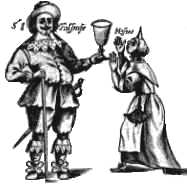
We know the names of over a thousand players between the years 1590 and 1642. Most of them were poor*, although perhaps twenty famous actors acquired respectable estates.*
Footnotes
-
An actor's wages
Philip Henslowe paid 5 shillings a week to hired men when the company was travelling; 10 shillings a week in London. The lowest pay for players was 1 shilling per day. Although their pay was low, hired men may have looked forward to the possibility of becoming sharers. The boys of the company earned even less--in 1600 the Admiral's Men paid one boy 3 shillings per week.
The usual fee for a play at court was 10 pounds. Although it was not a great amount, the companies which played at court gained prestige and royal protection from the City Fathers. Admission to the Globe and similar theatres was approximately one penny to one shilling; the Blackfriars ranged from 6 pence, to 2 shillings and 6 pence. The gallery receipts for the Admiral's Men was £20 a week on average in 1597, according to Henslowe's Diary.
(Go to the section on the value of money.)
-
Respectability at last
From 1572 to 1642, the social status of players rose, as they became connected to noble and eventually royal patrons. Elizabeth had the companies play at court four to eight times a year; James and Charles had twenty or more performances a season.
