Shakespeare's views?
Shakespeare himself, as ever, is impossible to pin down. There was certainly a wide range of belief within his audience.
The Bible is unequivocal about the existence of witches*; hence there were very few, if any, who would maintain that witches could not exist*. But writers like Scot show that others held more skeptical attitudes.
There is good evidence that Shakespeare had read Scot; certainly he read Samuel Harsnet's Declaration of Egregious Popish Impostures (1603), for he used many of the names of devils in it in Edgar's "mad" speeches in King Lear.* Harsnet's work is very much indebted to Scot, and is a thorough denunciation of belief in witchcraft.
Pets or "Familiars"?
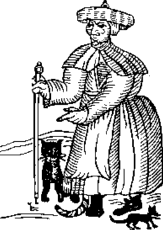
The Devil was supposed to appear to witches in the form of an animal, a cat, an owl, a mouse, and so on (see Leviticus* 19:31). In the first scene of Macbeth, the three witches respond to their familiars:
First Witch: I come Greymalkin [a grey cat].
Second Witch: Paddock [a toad] calls.
Third Witch [perhaps responding to an owl call]: Anon [at once]!
(1.1.8-9)
Thus an old woman who kept a cat, or whose house was infested with rats, could be accused of having familiars.
Samuel Harsnett's A Declaration of egregious Popish Impostures (1603) is on line.
Footnotes
-
Witches in the Bible
Leviticus 19: 31 reads "regard not them that have familiar spirits, neither seek after wizards, to be defiled by them"; there is also the story of the Witch of Endor, I Samuel 28: 7-25, where a king, Saul, goes to consult a witch--a passage of obvious relevance to Macbeth.
-
Of course they exist. . .
Even the skeptical Scot, in The Discoverie, wrote: "My question is not (as many fondly suppose) whether there be witches or nay; but whether they can do such miraculous works as are imputed to them."
-
Flibbertigibbet and friends
[Edgar:] This is the foul fiend Flibbertigibbet. . . Peace Smulkin, peace, thou fiend! . . . The Prince of Darkness is a gentleman. Modo, he's called, and Mahu.
(3.4.113, 138, 141-42)